ENIAC - Our Students Built a Super Computer
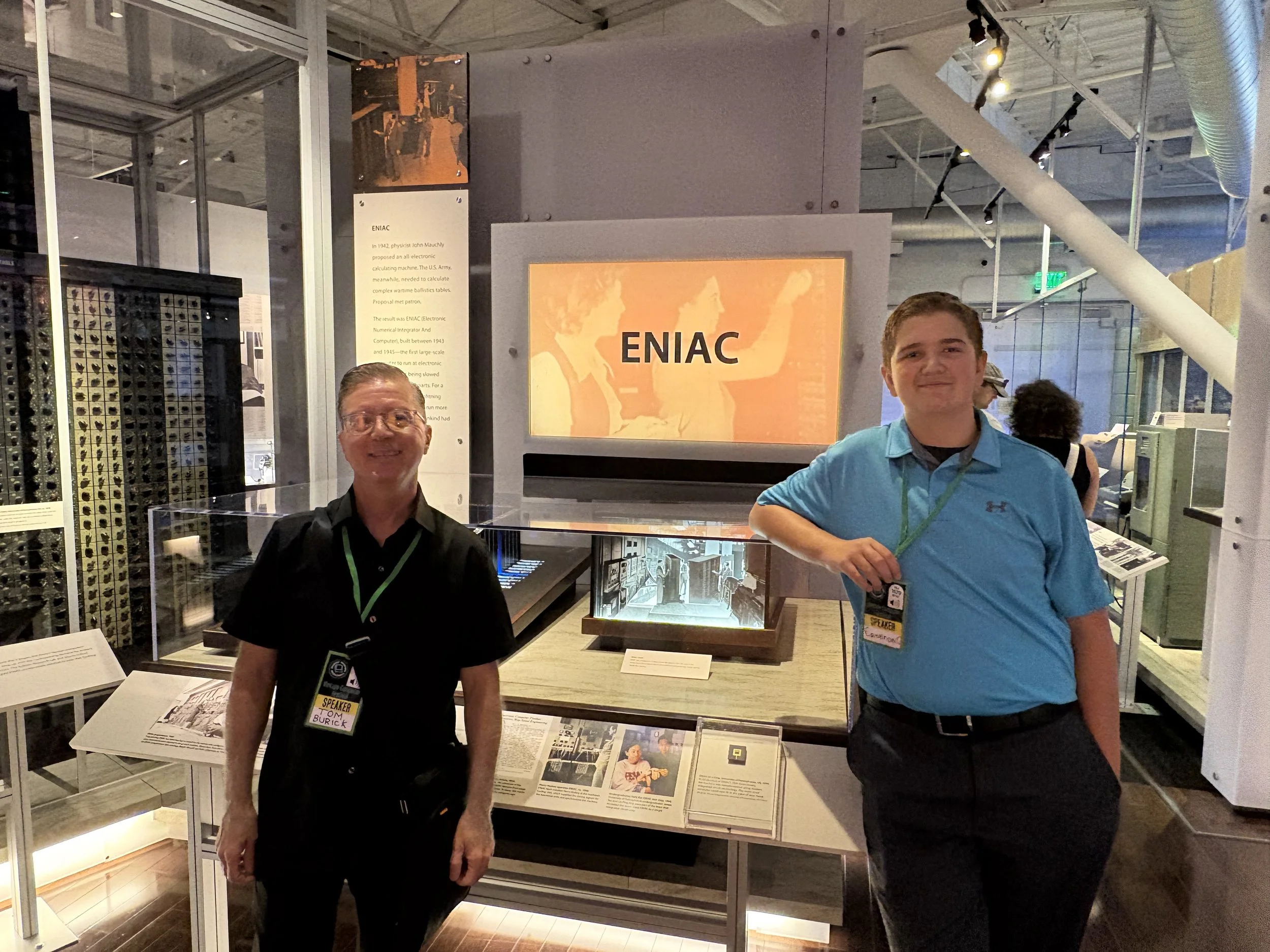
In 1945, the Electronic Numerical Integrator and Computer – ENIAC – rewrote the boundaries of what machines could do. It was the first general-purpose electronic digital computer, capable of performing thousands of operations per second using vacuum tubes rather than electromechanical relays. At nearly 30 tons, consuming roughly 150 kilowatts of power, and containing more than 17,000 vacuum tubes, ENIAC was not simply a computer; it was an industrial system, more comparable to a power plant than a modern desktop machine.
Today, ENIAC no longer exists as a complete, operational whole. Surviving units are distributed across museums, presented as isolated panels or artifacts. What has been missing for decades is the ability to experience the machine at scale – to stand inside the logic, to see how data physically flowed through space, wiring, and time.
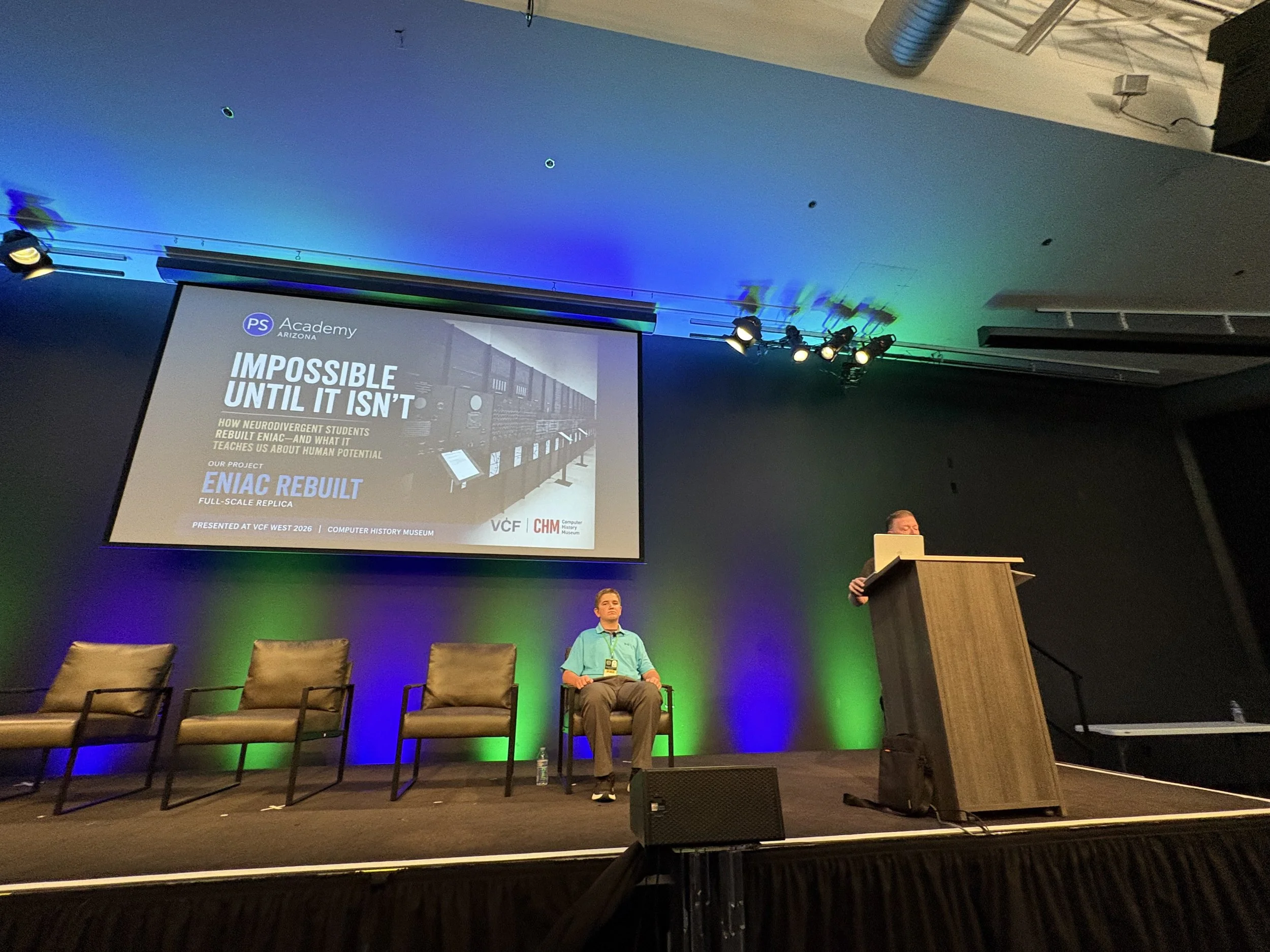
At PS Academy Arizona, a team of middle- and high-school students set out to reconstruct ENIAC at full scale, restoring not its electronics but its architecture. The result is a museum-grade, walk-through replica that reveals something difficult to convey through textbooks or schematics alone: early computing was spatial, manual, repetitive, and deeply physical.
Why Build a Replica at Full Scale?
Miniature models and digital simulations are valuable, but they flatten complexity. ENIAC’s design depended on physical separation of subsystems – accumulators, function tables, master programmer, constant transmitters – connected by thousands of hand-routed cables. Operators configured programs by plugging cords and setting rotary switches. Computation unfolded not only in time but in space.
A full-scale reconstruction preserves those relationships. Standing beside a 10-foot-long accumulator panel makes clear why programming ENIAC required teams of operators and why debugging was as much visual inspection as logical reasoning. Scale is not a cosmetic detail; it is a functional property of the system.
The students’ build reproduces the complete external form of ENIAC as installed at the University of Pennsylvania’s Moore School of Electrical Engineering in 1946. Dimensions, panel spacing, labeling, and layout were derived from original engineering drawings, wartime photographs, and archival documentation from the Computer History Museum and Drexel University.
Engineering Through Repetition
Original ENIAC construction involved approximately 5 million hand-soldered joints. While the replica does not recreate internal electronics, it does replicate the repetitive labor model that defined early computing manufacturing.
During six months, roughly 80 students invested more than 23,000 hours in hands-on construction – equivalent to more than a decade of full-time work by a single individual. They assembled hundreds of panels, aligned thousands of printed indicators, applied seven gallons of black paint, and laid down over half a mile of hot-melt adhesive. More than 3,200 square feet of cardboard – roughly the footprint of a large house – was cut, fitted, reinforced, and finished.
Precision mattered. Visual misalignment of even a few millimeters becomes obvious when multiplied across a wall-length array of panels. The students developed jigs, spacing guides, and repeatable workflows to maintain consistency across the machine. In doing so, they confronted the same problem faced by ENIAC’s original builders: how to achieve reliability through disciplined repetition.
Understanding ENIAC by Building It
ENIAC did not store programs in memory. Each new problem required physical reconfiguration – rewiring data paths and control signals by hand. This architectural constraint shaped both the machine’s operation and the thinking of its users.
Rebuilding ENIAC forces that realization. The students quickly discovered that questions like “Where does the data go next?” are not abstract. They are literal. Data traveled from panel to panel through visible conduits. Control pulses marched through the master programmer in fixed sequences. Timing, synchronization, and signal routing were design challenges experienced at human scale.
The replica makes clear why ENIAC excelled at tasks like artillery trajectory calculations and why it struggled with more generalized workflows. It also illuminates why stored-program architectures – introduced only a few years later – were such a profound conceptual leap.
Historical Accuracy as Responsibility
The project treats historical accuracy not as decoration but as obligation. Labels, fonts, color schemes, and panel layouts were matched to period references. Even the industrial casters supporting the panels were selected to match original military-spec hardware.
This fidelity matters because ENIAC occupies a foundational position in computing history. Simplifying or modernizing its presentation risks distorting the engineering realities of the era. The students approached the build as a form of historical reconstruction, comparable to restoring a vintage aircraft or industrial engine.
ENIAC historian Brian Stuart of Drexel University, who advised on the project, remarked during a visit that he found himself mentally tracing the flow of data through the replica – before remembering it had been built by students. The machine invites that kind of engagement because it is structurally correct.
Rethinking Who Builds Complex Systems
Every student on the ENIAC team is neurodivergent, with most on the autism spectrum. The project does not frame this as an obstacle overcome, nor as a human-interest angle. Instead, it highlights a straightforward reality: large-scale engineering systems often benefit from traits such as sustained focus, pattern recognition, tolerance for repetition, and attention to detail.
ENIAC itself was built by teams of specialists performing highly structured tasks. Its operation depended on precision, routine, and disciplined execution. The alignment between those demands and the cognitive strengths of the student builders is not incidental – it is instructive.
The project challenges assumptions about who is suited to engineering work by demonstrating capability through results. The replica stands as evidence.
What ENIAC Still Teaches Us
ENIAC was inefficient by modern standards, fragile by contemporary expectations, and astonishingly powerful for its time. Rebuilding it reminds us that computing did not emerge fully formed; it was constructed through iteration, labor, and risk.
For today’s engineers, the replica offers perspective. It reveals how architectural decisions are constrained by materials, energy, and manufacturing realities. It shows that abstraction layers we take for granted – compilers, operating systems, integrated circuits – rest on foundations built by people solving problems with slide rules and soldering irons.
Most importantly, it restores a sense of scale. ENIAC was not an idea; it was a machine you could walk beside, hear humming, and feel warming the air. Understanding that changes how we understand the origins of computing itself.
The students’ full-scale ENIAC does not merely commemorate history. It reconstructs understanding – one panel, one connection, and one carefully repeated operation at a time.
Thomas Burick is a Technology Instructor at PS Academy Arizona,an innovative school in Gilbert, Arizona, that supports neurodiverse middle and high school students in grades 6-12.By integrating academics, social-emotional development, and real-world skill building, the school helps students grow in confidence and independence while gaining the tools they need for success beyond the classroom.